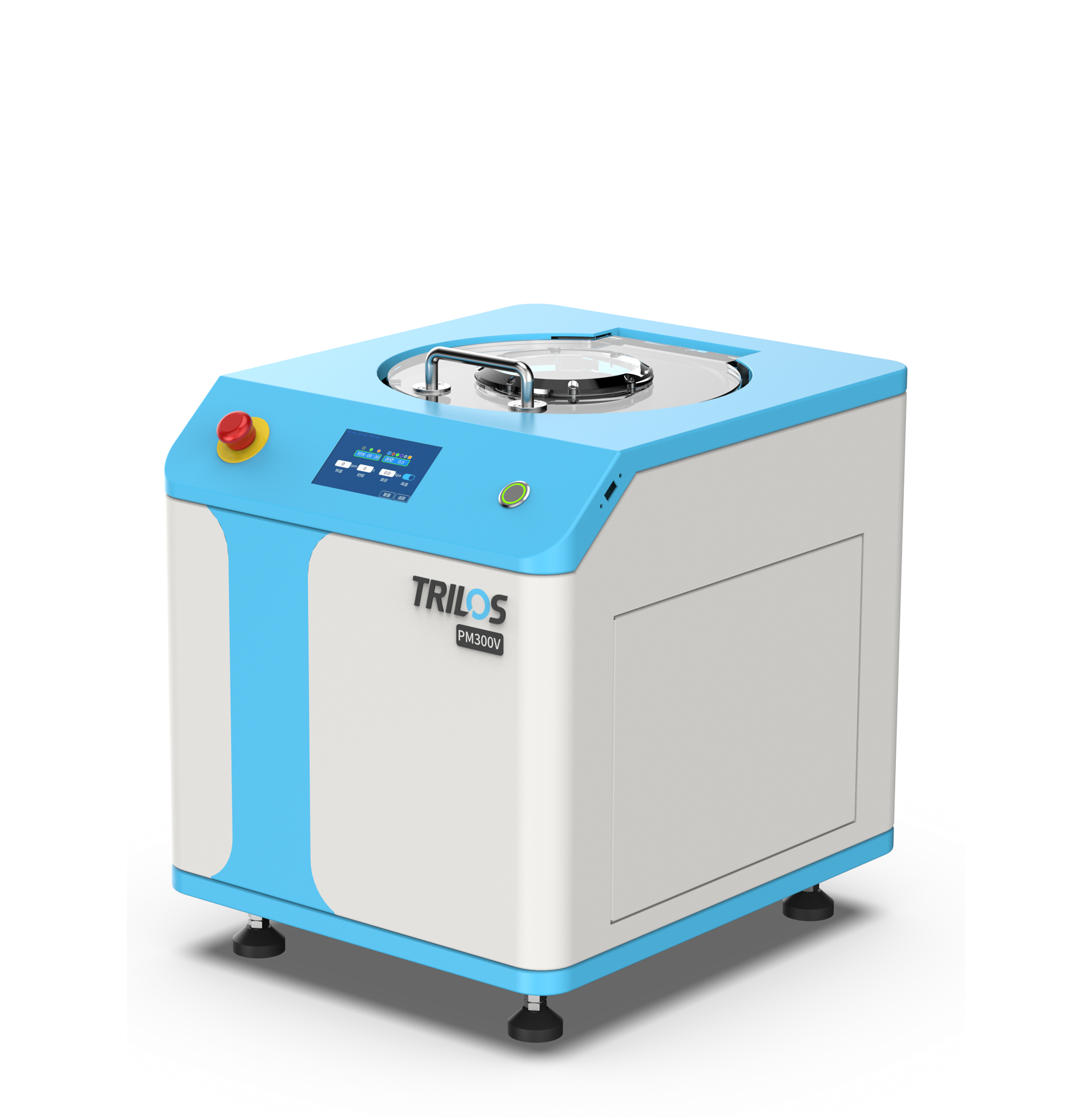


Abstract: The slurry of lithium battery needs to be finely mixed before coating. But the tiny bubbles in the slurry will have a negative impact on the coating procedure. An uneven coating flat of the lithium battery always causes serious defects of products. This article focuses on the best solution for removing the bubbles in the lithium battery. Basically, the method of processing is the planetary paste mixer. But the key for removing bubbles is the setting mode of the mixer. By adjusting the speed of the revolution and the rotation freely, the effect of bubble removing could be controlled by the mixer. But the traditional paste mixer can only just change the ratio of planetary system. It couldn't be fitted for the different pastes.
Lithium batteries are currently one of the rapidly rising directions in the new energy field. Especially in the past two years, with the adjustment of domestic policies in China and the expansion of the demand for clean energy, the production capacity of the domestic lithium battery industry has been continuously increasing. Various lithium battery suppliers have expanded their production capacity one after another to adapt to the trend of the expansion of the market demand gap.
The planetary vacuum paste mixer has great application and promotion prospects in the manufacturing process of lithium battery slurry. There are two main reasons. One is that the coating effect of the slurry after effectively removing submicron-sized bubbles is significantly improved. Another is that the slurry that has undergone defoaming treatment can effectively improve the quality of the electrode sheet and thus improving the yield of the backend module. This is the feedback from the actual experience of Samsung and LG factories in South Korea that have widely used this equipment for slurry processing.
The main working principle of the planetary vacuum paste mixer is that the combined movement is generated by the revolution and rotation of the equipment, so that the slurry per se is continuously and orderly turned in the tank, and then the extremely fine bubbles are squeezed out and removed by vacuum (see the movement synthesis simulation in the figure below). Since this equipment only uses the action of physical gravity and there is no direct contact mechanical structure, all submicron-sized bubbles in the material can be discharged.
Taking the mixing of graphite anode material as an example, due to the high adsorption property of graphite itself, the bubbles in the slurry are difficult to be discharged by natural placement. And if an equipment with a stirring mechanism is used for bubble mixing, more bubbles are likely to be generated.
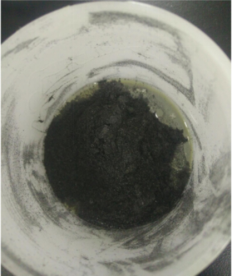
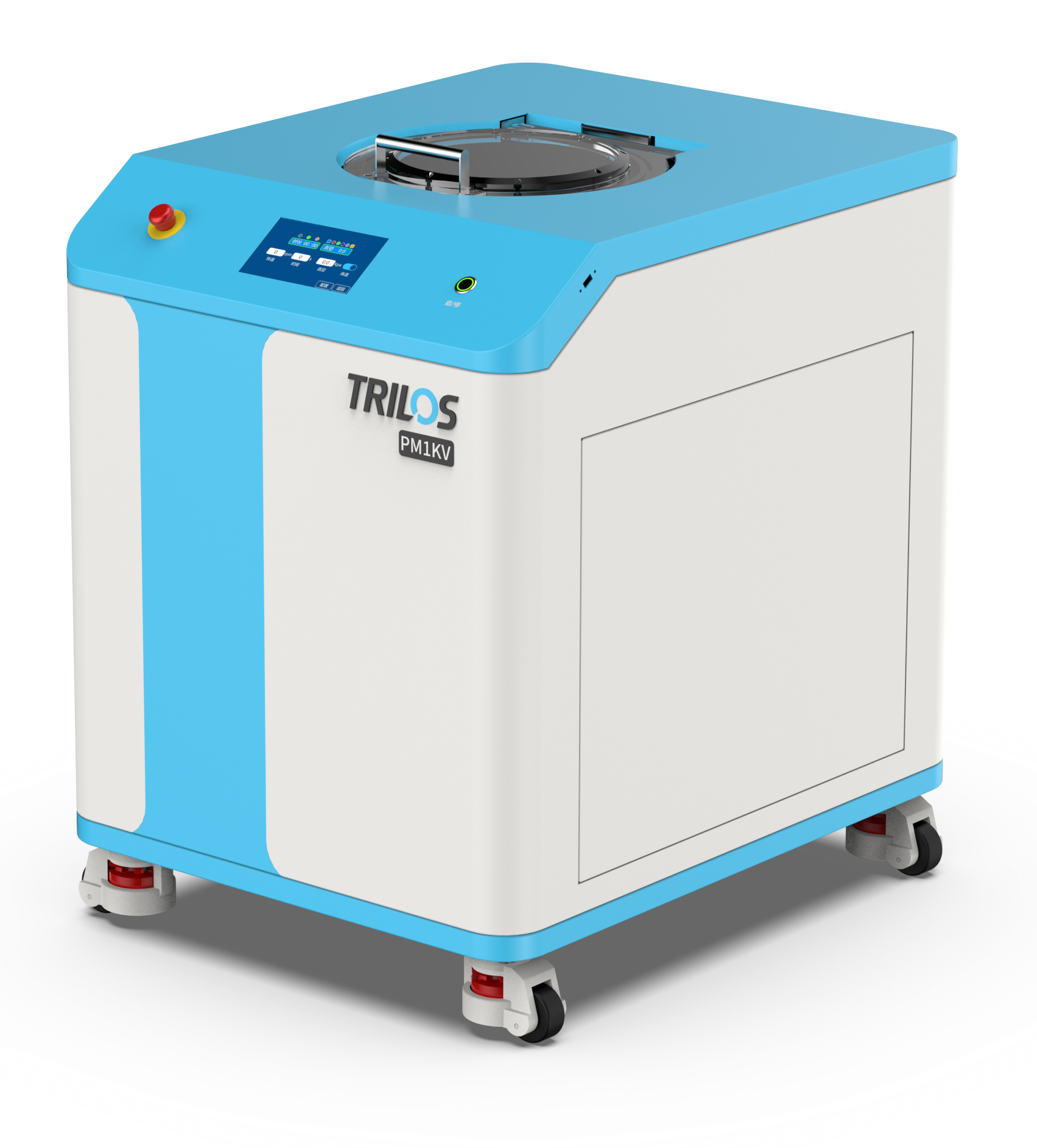
When we use the Trilos planetary vacuum paste mixer PM1KV for mixing, only the graphite powder and the organic solvent need to be placed in the tank at the same time (as shown in the figure above). Then, the tank can be directly placed in the equipment for mixing and defoaming operations.
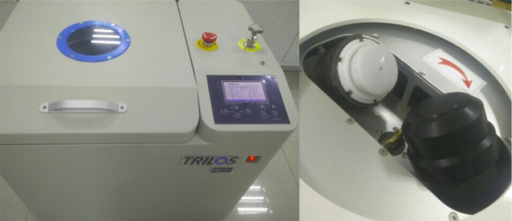
In order to effectively distinguish the role of the vacuum function in the slurry mixing and defoaming, the following two different parameter settings can be carried out:
|
Parameter Setting |
Revolution Speed |
Rotation Speed |
Time |
Vacuum |
|
Parameter a |
1150 rpm |
870 rpm |
2 min |
Off |
|
Parameter b |
1150 rpm |
870 rpm |
2 min |
On |
The final mixing effects are as follows respectively.
Mixing effect without using the vacuum function with parameter a:
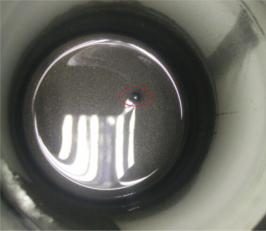
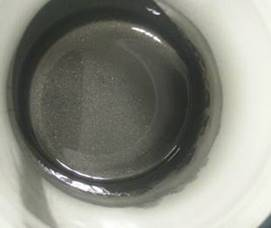
We can notice that the bubbles are marked in red and still adhere to the slurry surface, but obviously all the microbubbles are squeezed into a larger bubble.
Mixing effect with the vacuum function with parameter b:
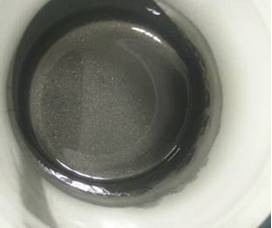
The single large bubble in the above figure has been completely removed by the vacuum system, and the slurry is mixed evenly.
It can be seen that even for the lithium battery slurry with graphite powder as the main component with extremely strong adsorption capacity, after the strong non-contact mixing and defoaming process, all the bubbles inside have been discharged. This can effectively improve the coating quality of the lithium battery slurry for the next coating process, thus improving the backend module abnormalities and defects caused by uneven coating from the source. The key is that currently this scheme can remove submicron-sized bubbles in the lithium battery slurry. Similarly, according to the actual feedback cases, this equipment also has good practical effects on the mixing and defoaming of ternary materials, adhesives and other related slurries.